
Swami Vivekananda
(1863-1902) was the foremost disciple of
Ramakrishna and a world spokesperson for Vedanta.
India's first spiritual and cultural ambassador to the West, came to represent the
religions of India at the World Parliament of Religions, held at Chicago in connection
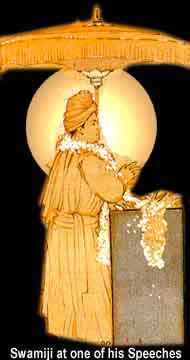
with the World's Fair (Columbian Exposition) of 1893. His Chicago speech is
uniquely Vedantic. Jawaharlal Nehru refers to
this universal dimension of Vivekananda in his Discovery of India. “Rooted in
the past, and full of pride in India’s heritage, Vivekananda was yet modern in
his approach to life’s problems, and was a kind of bridge between the past of
India and her present.”
 Vivekananda
said: "The Vedas teach that the soul is divine, only held
in the bondage of matter; perfection will be reached when this bond will burst, and the
word they use for it is, therefore, Mukti - freedom, freedom from the bonds of
imperfection, freedom from death and misery."
Vivekananda
said: "The Vedas teach that the soul is divine, only held
in the bondage of matter; perfection will be reached when this bond will burst, and the
word they use for it is, therefore, Mukti - freedom, freedom from the bonds of
imperfection, freedom from death and misery."
The Lord has declared to the Hindu in His incarnation as Krishna:
 He had said: “The time has come for the Hinduism of the
Rishis to become dynamic. Shall we stand by whilst alien hands attempt to
destroy the fortress of the Ancient Faith?…shall we remain passive or shall we
become aggressive, as in the days of old, preaching unto the nations the glory
of the Dharma?…In order to rise again, India must be strong and united, and
must focus all its living forces. To bring this about is the meaning of my
sannyasa!
He had said: “The time has come for the Hinduism of the
Rishis to become dynamic. Shall we stand by whilst alien hands attempt to
destroy the fortress of the Ancient Faith?…shall we remain passive or shall we
become aggressive, as in the days of old, preaching unto the nations the glory
of the Dharma?…In order to rise again, India must be strong and united, and
must focus all its living forces. To bring this about is the meaning of my
sannyasa!
 He had put immense faith in Hinduism:
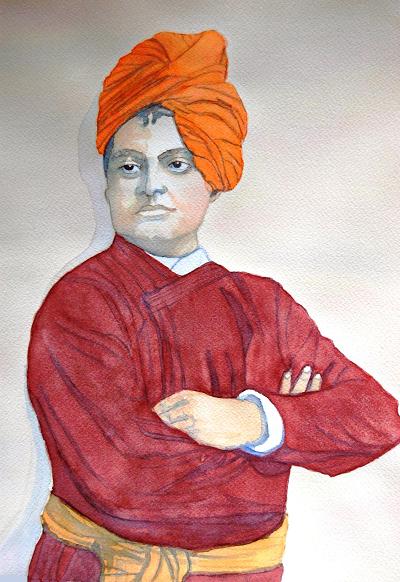
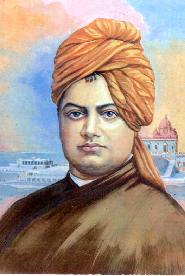
Swami Vivekananda - spokesperson for Vedanta.
India's first spiritual and cultural ambassador to the West.
(image source: Webmaster's
personal collection of art).
Refer to Chitra
Gallery.
***
The cyclonic monk from India” that is how
delegates to the Parliament of Religions at Chicago in 1894 described
Ramakrishna’s great disciple, Vivekananda. Romain
Rolland, in his admirable
biography of this “tamer of souls” refers
to Vivekananda’s dominating personality in these words: “a great voice is
meant to fill the sky. The whole world is its sounding-box…..Men like
Vivekanada are not meant to whisper. They can only proclaim. The sun cannot
moderate its own rays. He was deeply conscious of his role. To
bring Vedanta out of its obscurity and present it in a rationally acceptable
manner; to arouse among his countrymen an awareness of their own spiritual
heritage and restore their self-confidence; to
show that the deepest truths of Vedanta are universally valid, and that
India’s mission is to communicate these truths to the whole world
– these were the goals he set before himself.
(source:
The
Spirit of Modern India - Edited by Robert A McDermont and V. S.
Naravane p.6 - 7).
He said:
"From the high
spiritual flights of the Vedanta philosophy, of which the latest discoveries of science
seem like echoes, to the low ideas of idolatry with its multifarious mythology, the
agnosticism of the Buddhists and the atheism of the Jains, each and all have a place in
the Hindu's religion.
God is the ever-active providence, by whose power systems after systems are being evolved out of chaos, made to run for a time, and again destroyed.
God is the ever-active providence, by whose power systems after systems are being evolved out of chaos, made to run for a time, and again destroyed.
This is what the Brahmin boy repeats every day:
"The sun and the moon, the Lord
created like the suns and the moons of previous cycles."
And this agrees with modern science.
And this agrees with modern science.
Vivekananda
said: "The Vedas teach that the soul is divine, only held
in the bondage of matter; perfection will be reached when this bond will burst, and the
word they use for it is, therefore, Mukti - freedom, freedom from the bonds of
imperfection, freedom from death and misery."The Lord has declared to the Hindu in His incarnation as Krishna:
"I am in every religion as the thread through a string of pearls.
Wherever thou seest extraordinary holiness and extraordinary power raising and purifying
humanity, know thou that I am there."
(source: Swami Vivekananda Paper on Hinduism http://www.itihaas.com/modern/vivek-speech3.html).
(source: Swami Vivekananda Paper on Hinduism http://www.itihaas.com/modern/vivek-speech3.html).
For him India was
synonymous with the spirit of religion. He said "If
India is to die, religion will be wiped off the face of the earth."
Swami Vivekananda in his essay, The
Future of India:
"It is the same India which has withstood the
shocks of centuries, of hundreds of foreign invasions, of hundreds of upheavals
of manners and customs. It is the same land, which stands firmer than any rock
in the world, with its undying vigour, indestructible life. Its life is of the
same nature as the soul, without beginning and without end, immortal; and we are
the children of such a country."
(source: Hindutva
is liberal - By A. B. Vajpayee - rediff.com).
Swami
Vivekananda said about the
Bhagavad
Gita:
"No better commentary
on the Vedas has been written or can be written."
"Hinduism is the mother of all
religions" - so wrote Swami Vivekananda.
“This is the ancient land, where
wisdom made its home before it went into any other country… Here is the same
India whose soil has been trodden by the feet of the greatest sages that ever
lived… Look back, therefore, as far as you can, drink deep of the eternal
fountains that are behind, and after that look forward, march forward, and make
India brighter, greater, much higher, than she ever was.”
"Say
it with pride : we are Hindus", is
what Swami Vivekananda taught his fellow Hindus.
(source: Ayodhya and After - By Koenraad Elst).
(source: Ayodhya and After - By Koenraad Elst).
"Hindu Dharma is the quintessence of our national life, hold fast to it if you
want your country to survive, or else you would be wiped out in three
generations".
Swami
Vivekananda called upon his people to ‘rise, awake and acquire’ and reminded
them that
"Hindu religion does not consist in
struggles and attempts to believe a certain doctrine or dogma, but in realizing
not in believing, but in being and becoming."
(source:
India Rediscovered - By Dr. Giriraj
Shah p. 31 Abhinav Publications New Delhi 1975).
Swami Vivekananda: The fiery
monk from the East who
founded the Vedanta Society of America in 1894, was a champion of Mother India.
The
Hindu movement that he started became so successful in America, that Wendell
Thomas wrote a book called, 'Hinduism Invades America"
where he observes: "An old faith is now invading a new country."
Swami
Vivekananda also claimed: "I am proud to belong to a religion which has taught the
world both tolerance and universal acceptance."
"Say
it with pride : we are Hindus", is
what Swami Vivekananda taught his fellow Hindus.
***
Vivekananda
said if you want to do anything in India, do it with the
re-establishment of dharma or its reawakening. In India the soil and the dharma
(the upward aspiration) are one and the same, are body and soul.
(source: The
Soul of India - By Satyavrata R Patel p. 206).
Swami Vivekananda, who
founded the Vedanta Society of America in 1894, was a champion of Mother India.
He had said: “The time has come for the Hinduism of the
Rishis to become dynamic. Shall we stand by whilst alien hands attempt to
destroy the fortress of the Ancient Faith?…shall we remain passive or shall we
become aggressive, as in the days of old, preaching unto the nations the glory
of the Dharma?…In order to rise again, India must be strong and united, and
must focus all its living forces. To bring this about is the meaning of my
sannyasa!
(source: Hinduism
Invades America - By Wendell Thomas
p. 64 - 72 published by The
Beacon Press Inc. New York City 1930).
"By
what strange social alchemy has India subdued her conquerors, transforming them
to her very self and substance..... ? Why is it that her conquerors have not
been able to impose on her their language, their thoughts and
customs, except in superficial ways?"
(source: The empire strikes back - By Suma Varghese - Free Press Journal December 5 1997).
"If one religion is true, then all the others must also be true. Thus the Hindu faith is as yours as much as mine."
(source: http://www.geocities.com/hindusoc/special/hindintr.htm).
customs, except in superficial ways?"
(source: The empire strikes back - By Suma Varghese - Free Press Journal December 5 1997).
"If one religion is true, then all the others must also be true. Thus the Hindu faith is as yours as much as mine."
(source: http://www.geocities.com/hindusoc/special/hindintr.htm).
Vivekananda's philosophy was one of pride in the past. " Look back,
therefore, as far as you can, drink deep of the eternal fountains that are
behind, and after that, look forward, much forward, march forward and make India
brighter, greater, much higher than she ever was... We must go to the root of
this disease and cleanse the blood of all impurities.”
He had put immense faith in Hinduism:
"To my mind', our religion is truer than any other religion, because
it never conquered. Because it never shed blood, because its mouth
always shed on all, words of blessing, of peace, words of love and sympathy. It
is here and here alone that the ideals of toleration were first preached. And
it is here and here alone that toleration and sympathy become practical; it is
theoretical in every other country; it is here and here alone, that the Hindu
builds mosques for the Mohammedans and churches for the Christians.”
(source:
Secularization
of India…? - By S. Balasundar - Hindu voice).
Religion
is the main theme of India. Swami Vivekananda wrote:
"Each
nation, like each individual, has one theme in life, which is its center, the
principal note round which every note comes to form harmony....if one nation
attempts to throw off its vitality, the direction which has become its own
through the transmission of centuries, the nation dies....if one nation's
political power is its vitality, as in England, artistic life is another and so
on. In India religious life forms the center, the
keynote of the whole music of life."
(source:
Glimpses
of Indian Culture - By Dr. Giriraj Shah p. 27).
He proclaimed the
non-dualistic "spirituality" of Vedanta as the metaphysical root and
basis of universal tolerance and brotherhood, as well as of India's national
identity.
He said:
“India alone was to be, of all lands, the
land of toleration and of spirituality…in that distant time the
sage arose and declared, ekam sad vipra bahudha vadanti (He who exists is one;
the sages call him variously). This is one of the most memorable sentences that
was ever uttered, one of the grandest truths that was ever discovered. And for
us Hindus this truth has been the very backbone of our national existence…our
country has become the glorious land of religious toleration…The world is
waiting for this grand idea of universal toleration….The other great idea that
the world wants from us today….is that eternal ideal of the spiritual oneness
of the whole universe…This is the dictate of Indian philosophy. This oneness
is the rationale of all ethics and all spirituality.”
(source:
Vivekanada's Complete Works III, 186ff).
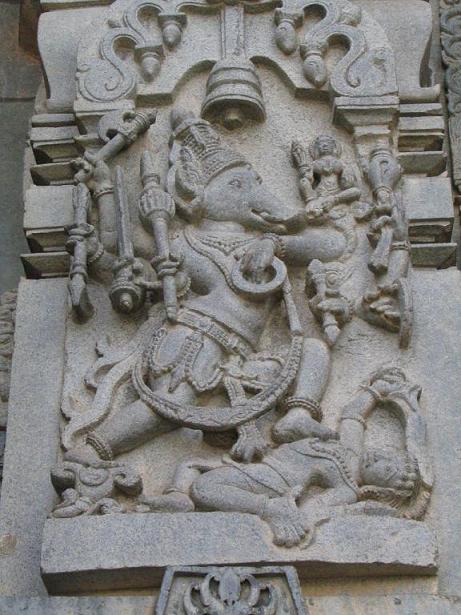
Lord Vishnu as Varaha avatar
incarnation.
“India alone was to be, of all lands,
the
land of toleration and of spirituality.
"I am proud to belong to a religion which has taught the
world both tolerance and universal acceptance."
For
more refer to chapter on Greater
India: Suvarnabhumi and Sacred
Angkor
***
"I am proud to belong to a religion which has taught the
world both tolerance and universal acceptance.
"We believe not only in universal toleration, but we accept all religions as
true. I am proud to belong to a country which has sheltered the persecuted and
the refugees of all religions and all countries of the earth. I am proud to tell
you that we have gathered in our bosom the purest remnant of the Israelites, who
came to southern India and took refuge with us in the very year in which their
holy temple was shattered to pieces by Roman tyranny. I am proud to belong to
the religion which has sheltered and is still fostering the remnant of the grand
Zoroastrian nation. I remember having repeated a hymn from my earliest boyhood,
which is every day repeated by millions of human beings:
"As the different streams having their sources
in different places all mingle their water in the sea, so, O Lord, the different
paths which men take through different tendencies, various though they appear,
crooked or straight, all lead to Thee." ....
(source: Swami
Vivekananda's speeches - The World Parliament of Religions.
Chicago Sept 11 1893).

This is dummy text. It is not meant to be read. Accordingly, it is difficult to figure out when to end it. But then, this is dummy text. It is not meant to be read. Period.
Be The First Among Your Friends To Comment On Bhartiya Hindu Sangh! ConversionConversion EmoticonEmoticon